
This Golden Angel Hides a Mystical Prague Secret
Stand beneath the gilded figure on Celetná Street and you’ll discover more than just beautiful baroque art. You’ll be at the threshold of one of Europe’s most intriguing alchemical mysteries – a divine messenger who has watched over travellers, merchants, and seekers of hidden knowledge for centuries.
The Divine Messenger Waiting Above Your Head
As you walk down Celetná Street towards Prague’s Old Town Square, look up at number 29. There, perched above what was once a coaching inn1, sits a golden statue that most tourists rush past.
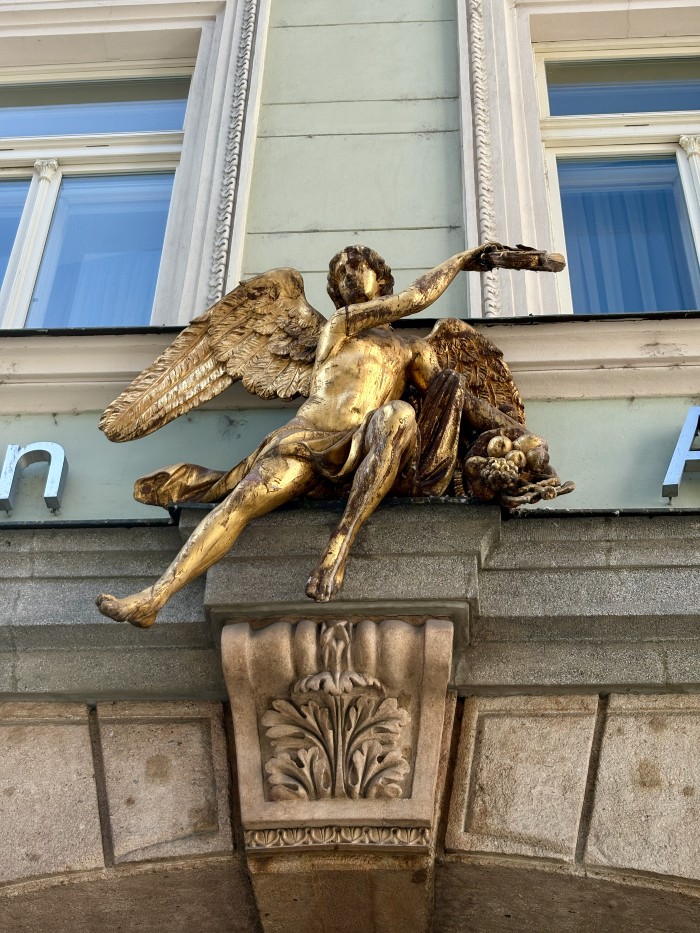
The statue depicts a youthful, winged figure holding objects revealing his true identity. In one hand, he grasps a laurel wreath, symbol of victory and honour. In the other, he holds a cornucopia – a horn overflowing with fruit, representing abundance and prosperity. But look closer, just beneath that horn of plenty. You’ll spot the telltale sign that transforms this “angel” into something more significant. It is a caduceus, Mercury’s2 winged staff entwined with serpents3 4.
The statue is Mercury, the Roman god of commerce, travel, and transformation5. His presence here tells a story that weaves mythology, alchemy, and Prague’s magical history.

This is a replica; the original one is in Prague’s Municipal Museum close to the lost train station of Tesnov.
This building is the House at the Golden Angel6, and it saw centuries of Prague’s history. It began as five separate medieval houses where the Knights Templar once lived7. By the 18th century, these buildings were joined to create a coaching inn called “At the new tavern”.8 Mozart stayed here in 1787 when he came to stage his opera Don Giovanni at the nearby Estates Theatre. In 1860, the owners rebuilt it in the Classicist style.9. It became the luxurious Hotel at the Golden Angel, hosting royalty and revolutionaries10.
The baroque statue we see today dates back to the current classical appearance. Records don’t reveal the specific sculptor’s name. The golden finish catches the light, making Mercury seem to glow in the sun – a beacon for those who knew what to look for.
The Caduceus: More Than a Pretty Staff

Mercury’s caduceus isn’t merely decorative. This winged staff, with two serpents coiled around it in perfect symmetry, is one of the most powerful symbols in Western mythology11. According to Greek legend, Hermes (Mercury’s Greek counterpart) received this staff from Apollo in exchange for the lyre he had invented from a tortoise shell12. The staff had extraordinary powers: it could wake the sleeping or send the wakeful to sleep13.
The serpents themselves carry deep meaning. One myth tells how Hermes came upon two snakes locked in mortal combat. When he placed his staff between them, they ceased fighting and wrapped themselves around the rod, transforming a symbol of conflict into one of peace and harmony14 15.
In Roman mythology, Mercury wielded the caduceus as both herald and guide16 17. He was the messenger who carried communications from Jupiter to mortals below18, and the conductor of souls who led the newly dead from the world of the living into the underworld19 20 21. The caduceus was his badge of office, marking him as having divine authority to cross boundaries that other gods could not.
The staff also is associated with commerce22 23 24 and negotiation, two realms where Mercury held sway. Merchants25 26 27 would pray to Mercury for profitable ventures and safe travels, making his symbol appropriate above the entrance to a coaching inn that welcomed traders and travellers from across Europe.

How Mercury Differs from Greek Hermes
Whilst Mercury and Hermes share many similarities, they are not identical:
- Hermes emerged from Mycenaean and Aegean traditions28. In Greek mythology, Hermes stole Apollo’s sacred cattle within hours of his birth29, demonstrating his trickster nature from the start.
- Mercury arose from earlier Italic and Etruscan deities of commerce known as the Dei Lucrii30. For the Romans he is a ceremonial herald and guide, with less emphasis on mischievous pranks.
The Alchemical Gateway: Why Mercury Stands Here
Mercury’s placement on Celetná Street is no accident. This ancient thoroughfare forms part of Prague’s Royal Route – the ceremonial path Czech kings followed during their coronation processions from the Powder Tower through the Old Town to Prague Castle. For those versed in esoteric knowledge, this route had another significance: it was the Alchemist’s Trail, a symbolic journey of transformation marked by carefully placed symbols that guided initiates through the stages of the Great Work.
I’ve written about the Royal Route and the alchemist’s trail.

Mercury was a central figure in alchemy31. Medieval alchemists believed him to be the author of the Hermetic texts that contained divine revelations about transforming matter and spirit32. The caduceus became an alchemical symbol indicating preparations containing the metal mercury (quicksilver), which alchemists considered the fundamental component of all matter and a main ingredient for the philosopher’s stone.
Prague’s Mystical Heritage: A City of Transformation
Prague’s connection to alchemy and esoteric knowledge runs deep. Emperor Rudolf II transformed the city into Europe’s intellectual and artistic capital33, inviting mathematicians, astronomers, artists, philosophers, and alchemists to his court. Among his guests were Tycho Brahe, Johannes Kepler, John Dee, and countless others seeking to unlock nature’s deepest secrets.
Tycho Brahe died in Prague too.
The Emperor himself worked in an alchemical laboratory within Prague Castle34, not to create gold for wealth, but to understand divine wisdom through the discipline of transformation35. He collected an extraordinary Kunstkammer filled with wonders, and Prague became an island of intellectual and religious tolerance between Catholicism, Protestantism, and Islam36 37.


Prague and Mercury today
When you stand beneath Mercury’s golden gaze on Celetná Street, you’re standing at a threshold. This baroque figure represents more than artistic beauty or mythological knowledge. He embodies the spirit of transformation that has defined Prague for centuries.
Mercury reminds us that travel isn’t just about moving through space – it’s about crossing boundaries, both external and internal. As the guide of souls and the messenger between worlds, he invites you to see beneath the surface of Prague’s stunning architecture to the layers of meaning hidden there.
The next time you walk past the House at the Golden Angel, pause for a moment. Look up at Mercury with his caduceus, his cornucopia overflowing. He’s been waiting for centuries, ready to guide seekers through Europe’s most enchanting city.
Perhaps you’ll discover what the alchemists sought – not literal gold, but the transformation that comes from truly seeing the world around you.
References
- Muller, M. (2013) Celetna Lane in Prague [online]. Available from: http://www.prague.cz/celetna-lane/ (Accessed 26 October 2025).[↩]
- The Editors of Encyclopedia Britannica (2018) Mercury | Roman god. Encyclopædia Britannica [online]. Available from: https://www.britannica.com/topic/Mercury-Roman-god.[↩]
- Giummara, S. (2023) The symbols of medicine: a story of snakes, staffs and Greek gods [online]. Available from: https://blog.sciencemuseumgroup.org.uk/the-symbols-of-medicine/.[↩]
- Shapiro, J. M. and S. O. (n.d.) Hermes. uen.pressbooks.pub. [online]. Available from: https://uen.pressbooks.pub/mythologyunbound/chapter/hermes/.[↩]
- Wasson, D. (2018) Mercury (Deity) [online]. Available from: https://www.worldhistory.org/Mercury_(Deity)/.[↩]
- Muller, M. (2013) Celetna Lane in Prague [online]. Available from: http://www.prague.cz/celetna-lane/ (Accessed 26 October 2025).[↩]
- Local Expert (2015) House At the Golden Angel – Prague Guide [online]. Available from: https://www.prague-guide.co.uk/house-at-the-golden-angel/ (Accessed 26 October 2025).[↩]
- Local Expert (2015) House At the Golden Angel – Prague Guide [online]. Available from: https://www.prague-guide.co.uk/house-at-the-golden-angel/ (Accessed 26 October 2025).[↩]
- Local Expert (2015) House At the Golden Angel – Prague Guide [online]. Available from: https://www.prague-guide.co.uk/house-at-the-golden-angel/ (Accessed 26 October 2025).[↩]
- Local Expert (2015) House At the Golden Angel – Prague Guide [online]. Available from: https://www.prague-guide.co.uk/house-at-the-golden-angel/ (Accessed 26 October 2025).[↩]
- Friedlander, W. J. (1992) The Golden Wand of Medicine. Praeger.[↩]
- Shapiro, J. M. and S. O. (n.d.) Hermes. uen.pressbooks.pub. [online]. Available from: https://uen.pressbooks.pub/mythologyunbound/chapter/hermes/.[↩]
- Anon (2018) Hermes – Greek Mythology [online]. Available from: https://www.greekmythology.com/Olympians/Hermes/hermes.html (Accessed 26 October 2025).[↩]
- Friedlander, W. J. (1992) The Golden Wand of Medicine. Praeger.[↩]
- Giummara, S. (2023) The symbols of medicine: a story of snakes, staffs and Greek gods [online]. Available from: https://blog.sciencemuseumgroup.org.uk/the-symbols-of-medicine/.[↩]
- Wasson, D. (2018) Mercury (Deity) [online]. Available from: https://www.worldhistory.org/Mercury_(Deity)/.[↩]
- Dhar, R. (2022) Mercury: Roman God of Trade and Commerce | History Cooperative [online]. Available from: https://historycooperative.org/mercury-roman-god/.[↩]
- Wasson, D. (2018) Mercury (Deity) [online]. Available from: https://www.worldhistory.org/Mercury_(Deity)/.[↩]
- Shapiro, J. M. and S. O. (n.d.) Hermes. uen.pressbooks.pub. [online]. Available from: https://uen.pressbooks.pub/mythologyunbound/chapter/hermes/.[↩]
- Wasson, D. (2018) Mercury (Deity) [online]. Available from: https://www.worldhistory.org/Mercury_(Deity)/.[↩]
- Dhar, R. (2022) Mercury: Roman God of Trade and Commerce | History Cooperative [online]. Available from: https://historycooperative.org/mercury-roman-god/.[↩]
- The Editors of Encyclopedia Britannica (2018) Mercury | Roman god. Encyclopædia Britannica [online]. Available from: https://www.britannica.com/topic/Mercury-Roman-god.[↩]
- Giummara, S. (2023) The symbols of medicine: a story of snakes, staffs and Greek gods [online]. Available from: https://blog.sciencemuseumgroup.org.uk/the-symbols-of-medicine/.[↩]
- Dhar, R. (2022) Mercury: Roman God of Trade and Commerce | History Cooperative [online]. Available from: https://historycooperative.org/mercury-roman-god/.[↩]
- The Editors of Encyclopedia Britannica (2018) Mercury | Roman god. Encyclopædia Britannica [online]. Available from: https://www.britannica.com/topic/Mercury-Roman-god.[↩]
- Dhar, R. (2022) Mercury: Roman God of Trade and Commerce | History Cooperative [online]. Available from: https://historycooperative.org/mercury-roman-god/.[↩]
- Wasson, D. (2018) Mercury (Deity) [online]. Available from: https://www.worldhistory.org/Mercury_(Deity)/.[↩]
- Atsma, A. (2000) HERMES – Greek God of Herds & Trade, Herald of the Gods [online]. Available from: https://www.theoi.com/Olympios/Hermes.html.[↩]
- Atsma, A. (2000) HERMES – Greek God of Herds & Trade, Herald of the Gods [online]. Available from: https://www.theoi.com/Olympios/Hermes.html.[↩]
- Woman, W. (2010) Mercury vs. Hermes [online]. Available from: https://wanderingwomanwondering.wordpress.com/2010/05/22/mercury-vs-hermes/ (Accessed 26 October 2025).[↩]
- Giummara, S. (2023) The symbols of medicine: a story of snakes, staffs and Greek gods [online]. Available from: https://blog.sciencemuseumgroup.org.uk/the-symbols-of-medicine/.[↩]
- Giummara, S. (2023) The symbols of medicine: a story of snakes, staffs and Greek gods [online]. Available from: https://blog.sciencemuseumgroup.org.uk/the-symbols-of-medicine/.[↩]
- Rady, M. (2022) The Alchemist Emperor of Prague [online]. Available from: https://quillette.com/2022/05/27/the-alchemist-emperor-of-prague/.[↩]
- Rady, M. (2022) The Alchemist Emperor of Prague [online]. Available from: https://quillette.com/2022/05/27/the-alchemist-emperor-of-prague/.[↩]
- Marshall, P. (2009) The Magic Circle of Rudolf II. Bloomsbury Publishing USA.[↩]
- Rady, M. (2022) The Alchemist Emperor of Prague [online]. Available from: https://quillette.com/2022/05/27/the-alchemist-emperor-of-prague/.[↩]
- Marshall, P. (2009) The Magic Circle of Rudolf II. Bloomsbury Publishing USA.[↩]
Would you like to receive more of this kind of content by email? Fill in your details and we'll keep you up to date!