
The Fruttuaria Abbey
A King Died Here. Then the Church Buried It. Then a Plumber Found It Again.
The Abbazia di Fruttuaria has been a monastery, a political pawn, a makeover project, and a school. What lies beneath the floor is one of the most remarkable archaeological finds in northern Italy — and almost nobody knows about it.
- There’s a thousand years of European history stacked on top of itself.
- Two abbeys in one.
- A Romanesque campanile standing next to an 18th-century Baroque facade.
- And, under the floor, a mosaic carpet discovered by accident.
If you care about the sheer stubborn persistence of the past — read on.
How It All Began: A Monk, a King, and a Reform Movement
To understand Fruttuaria, you need to understand one man: Guglielmo da Volpiano1. He’s known in the wider world as William of Volpiano, or William of Saint-Bénigne of Dijon2.

William was born in 962 on the Isola San Giulio d’Orta3 near Novara, the son of a Lombard count4. As a child, he was given as an oblate to the Benedictine monastery of San Genuario at Locedio, Vercelli5. He later studied there and in Pavia6. In 987 he met Abbot Majolus of Cluny who took him under his wing7. This was a meeting that would change the trajectory of European monasticism.
The city of Cluny, in Burgundy, was the epicentre of what historians call the Cluniac Reform. This was a movement to restore the strict observance of the Rule of Saint Benedict, with an emphasis on liturgy, scholarship, and independence from secular interference8. William became one of its most effective agents. By 990 he was elected abbot of Saint-Bénigne in Dijon9, and over the following decades he reformed monasteries across Burgundy, Normandy, and northern Italy. By the time of his death in 1031, he ruled forty monasteries10 11.
Fruttuaria was his Italian masterpiece12. In 1001–1003, with the backing of Arduin of Ivrea — his uncle13 14, and the first and only native Italian to be crowned King of Italy – William laid the foundations of a new abbey15 16 17 on the fertile plain of the Canavese. He placed the first stone on 23 February 100318 19 20 21, consecrated by the Bishop of Ivrea, in Arduin’s presence22. The monastery was ready by 1006–1007 and, of course, followed the Benedictine Rules23.
The name Fruttuaria derives from the Latin fructuaria — fruitful land — a reference to the agricultural richness of the surrounding plain.

The abbey’s influence spread rapidly. It became the nucleus of the Congregatio Fructuariensis, a network of reformed Benedictine houses that extended across northern Italy, Corsica, and as far as Lorraine and Germany24.
Part of this growth, and influence, came from wealthy benefactors. Guglielmo-Otto of Ivrea, an ancestor of mine, was the Count of Burgundy and he donated land to the Abbey, in return for prayers for the souls of his family.
Arduin himself retired to the abbey after abdicating his throne, and died there on 14 December 101525 26. When Empress Agnes of Germany visited in 106527 28, she was so impressed by the customs of Fruttuaria that she was instrumental in introducing them to Saint Blaise Abbey in Baden-Württemberg29 30.
Fruttuaria was not a local institution. It was a European one.
A Thousand Years of Change: The Abbey’s Timeline
The story of Fruttuaria is not a straight line. It is a series of rises, falls, demolitions, and rediscoveries. After its foundational story, here’s how it evolved:
- 12th–13th centuries: At its peak it controls 85 churches in Italy, four communes (quattro terre abbaziali: San Benigno Canavese, Montanaro, Lombardore, and Foglizzo). It also had possessions in present-day France and Austria. It houses approximately 1 200 monks and mints its own coin31 32 33.

- 14th century — Decline sets in, driven by the corrupting effects of excessive wealth and the system of commenda (absentee abbots)34 35.
- 1477 — Pope Sixtus IV gives the abbey into commendation36
- 1585 — Pope Sixtus V suppressed the monastery. The buildings are converted into a college of secular priests (a collegiate church)37 38 39 40.
- 1634 — The last monk dies41.
- 1710: Troops of Victor Amadeus II, Duke of Savoy, occupy the lands42 43.
- 1741: The occupation ends with papal renunciation of territorial control. Pope Benedict XIV excommunicates the commendatory abbots44.
- 1770 — Cardinal Vittorio Amedeo delle Lanze commissions a new church45 46.
- Napoleonic era (c. 1803) — French forces destroy the library, suppress the school, sell the contents, and abolish the abbatial territory47.
- 1848 — The Piedmont government suppressed the abbey48.
- 1879 — The complex is entrusted to Don Bosco and his Salesians. They establish a professional school on the site49.
- 14 December 1979 — During works to install central heating, a worker’s drill breaks through the floor. He reveals an 11th-century mosaic depicting two griffons50 51 52 53.
- 1980–1991 — Systematic archaeological excavations reveal the full foundations of the Romanesque church54.
- 19 March 1990 — Pope John Paul II visits Fruttuaria55.

- 2004 — Restorations concluded56. Volunteers founded the charity, Amici di Fruttuaria (EN: Friends of Fruttuaria) on 25 May 2004, opening an archaeological route to the public57.
- 2024 — The Amici di Fruttuaria celebrate their 20th anniversary. They guided over 108,000 visitors58.
What You Actually See: The Architecture and Art
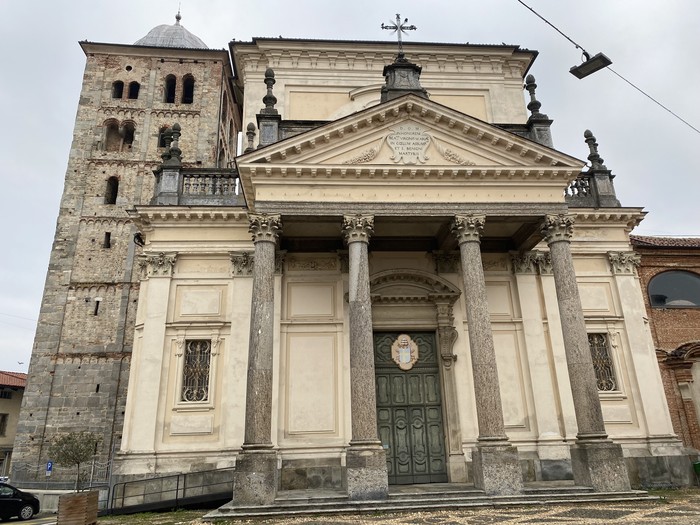
Standing in the piazza opposite the abbey you are confronted with one of the most visually striking architectural juxtapositions in Piedmont. On your left: a massive Romanesque stone campanile59, raw and uncompromising. On your right: a creamy Baroque facade with Corinthian columns, a pediment, and ornamental stonework. They do not look like they belong together. That is because they are, in a sense, from different worlds; separated by seven and a half centuries of history.
The Romanesque Campanile (Bell Tower)
The campanile is the only surviving element60 of William of Volpiano’s original 1003 abbey. It is a formidable structure: a square tower of six storeys, built from large ashlar stone blocks at the base. It has a characteristic Lombard Romanesque feature of archetti pensili in cotto (EN: small hanging arches in terracotta) that mark each storey level. As the photos here show, the lower three floors are lit by narrow loopholes but the fourth has a single-light window. The upper floors have pairs of mullioned windows with clothes-hanger capitals.
Inside, a stone staircase leads to the belfry. During excavations, they rediscovered a lower chapel within the tower base. Its upper apse preserved traces of an 11th-century fresco depicting the Virgin Enthroned with Child. Traces of an 11th or 12th century mosaic floor with plant and geometric motifs were also found within the tower.

The Baroque Church (1770)
The church you see above ground today was designed by Bernardo Antonio Vittone61 62 (1704–1770) , one of the three great masters of Piedmontese Baroque63. It was completed after his death by his collaborator Mario Ludovico Quarini64 65 (c.1736–c.1800). Vittone died in 1770, the same year the project was commissioned66 67. This poignant detail that means the building is as much Quarini’s work as his.
The facade is a confident exercise in late Baroque classicism68. It has a deep portico of Corinthian columns in grey marble, with a papal coat of arms on the door and a triangular pediment bearing the inscription:
D.O.M. / In Honorem Beatae Virginis Mariae in Coelum Assumptae et S. Benigni Martyris
To God the Greatest: In Honour of the Blessed Virgin Mary Assumed into Heaven and of Saint Benignus, Martyr
The building is grand on purpose — it was, after all, a statement of patronage as much as a place of worship.
What is less obvious from the outside is that this church squats on top of the medieval one. The original building had three short naves or aisles cut by a transept69 70, onto which five chapels opened71 72. This innovative design that allowed multiple monks to celebrate the liturgy simultaneously73 74.

The 18th-Century Cloister
The cloister is the organisational heart of the complex. Its plan is an irregular octagon, derived from a rectangle of four arcades by three, with bevelled angles, making it a sophisticated piece of late 18th-century spatial planning. The masonry of the second level preserves the signs of unfinished work, with bricks placed in a stepwise fashion for grafting the vaults. The roof with wooden trusses dates from 1783.
During recent restoration works, four small Romanesque masonry arches emerged within the cloister walls. These truncated conical capitals on small columns, all in plastered masonry, are a ghost of the earlier structure that the 18th-century builders had buried but not entirely erased.
The Mosaics
Perhaps the most spectacular discovery at Fruttuaria is the 11th or 12th century mosaic floor of the presbytery. The flooring around the altar of the cross was replaced around 1060 which coincides with the period of Empress Agnes’s stay. The result is a series of mosaics featuring animal figurations: griffons, lions, eaglets, intersecting circles, stylised leaves, and vegetable shoots contained within panels75.

The mosaic covers an area approximately 9 metres long by 5.5 metres wide76. It is executed in white and black tesserae with polychrome inserts of fired clay and coloured glass paste. The south panel is the better-preserved of the two that flank the altar. It shows two rampant griffons separated by the Tree of Life. The north panel, more fragmentary, contained two lions. A lower band features four eaglets, an imperial symbol, within rhomboidal frames, completed by two more griffons (a Christological symbol) beneath an arcade in front of the Tree of Life.
The typology of the floral decorative motifs, as the panel notes, “harks back to a taste of oriental derivation mediated by the imagery present in fabrics and by knowledge of the late ancient mosaic work present in the basin of the upper Adriatic.”77. These are among the oldest surviving mosaics in Piedmont78.
The Rotunda of the Holy Sepulchre
Behind the altar of the cross, at the crossing of the nave and transept, stands a small circular masonry structure. This is the Rotunda of the Holy Sepulchre79 80, modelled on the Church of the Holy Sepulchre in Jerusalem. It dates to the earliest construction phases of the abbey (1003–1007) and was used by the monks in the Easter morning procession. It is one of the earliest surviving examples of this type of liturgical rotunda in northern Italy.
Fruttuaria Today
The abbey did not disappear after 1848 as shown in the timeline above.
Today, the archaeological and artistic heritage of the site is managed by the charitable “Friends of Fructuaria”. In January 2024, the association spoke to local press about plans for the 20th anniversary year. Their ambition is to make it accessible and relevant to new audiences.
Fruttuaria is not on the tourist trail. It does not have a gift shop full of refrigerator magnets. It is open for two hours on alternate Sundays. In one compact site you can find the full arc of medieval European monasticism – reform, politics, vanity. And the quiet persistence of volunteers who refuse to let it fade away.
References
- SpottingHistory (n.d. ) ‘Abbey of Fruttuaria, San Benigno Canavese, Italy’. Available at: https://www.spottinghistory.com/view/12765/abbey-of-fruttuaria/ [Accessed 4 March 2026][↩]
- De Piccoli, I. ‘Fruttuaria, Abbey of’ in New Catholic Encyclopedia. Cengage/Encyclopedia.com. Available at: https://www.encyclopedia.com/religion/encyclopedias-almanacs-transcripts-and-maps/fruttuaria-abbey [Accessed 4 March 2026][↩]
- Hamilton, B. ‘William of Saint-Bénigne of Dijon, St.’ in New Catholic Encyclopedia. Cengage/Encyclopedia.com. Available at: https://www.encyclopedia.com/religion/encyclopedias-almanacs-transcripts-and-maps/william-saint-benigne-dijon-st [Accessed 4 March 2026][↩]
- Hamilton, B. ‘William of Saint-Bénigne of Dijon, St.’ in New Catholic Encyclopedia. Cengage/Encyclopedia.com. Available at: https://www.encyclopedia.com/religion/encyclopedias-almanacs-transcripts-and-maps/william-saint-benigne-dijon-st [Accessed 4 March 2026][↩]
- Hamilton, B. ‘William of Saint-Bénigne of Dijon, St.’ in New Catholic Encyclopedia. Cengage/Encyclopedia.com. Available at: https://www.encyclopedia.com/religion/encyclopedias-almanacs-transcripts-and-maps/william-saint-benigne-dijon-st [Accessed 4 March 2026][↩]
- Hamilton, B. ‘William of Saint-Bénigne of Dijon, St.’ in New Catholic Encyclopedia. Cengage/Encyclopedia.com. Available at: https://www.encyclopedia.com/religion/encyclopedias-almanacs-transcripts-and-maps/william-saint-benigne-dijon-st [Accessed 4 March 2026][↩]
- Hamilton, B. ‘William of Saint-Bénigne of Dijon, St.’ in New Catholic Encyclopedia. Cengage/Encyclopedia.com. Available at: https://www.encyclopedia.com/religion/encyclopedias-almanacs-transcripts-and-maps/william-saint-benigne-dijon-st [Accessed 4 March 2026][↩]
- Benedict XVI (2009 ) ‘General Audience of 11 November 2009: The Cluniac Reform’. Vatican City: Holy See. Available at: http://www.vatican.va/content/benedict-xvi/en/audiences/2009/documents/hf_ben-xvi_aud_20091111.html [Accessed 4 March 2026][↩]
- Hamilton, B. ‘William of Saint-Bénigne of Dijon, St.’ in New Catholic Encyclopedia. Cengage/Encyclopedia.com. Available at: https://www.encyclopedia.com/religion/encyclopedias-almanacs-transcripts-and-maps/william-saint-benigne-dijon-st [Accessed 4 March 2026][↩]
- De Piccoli, I. ‘Fruttuaria, Abbey of’ in New Catholic Encyclopedia. Cengage/Encyclopedia.com. Available at: https://www.encyclopedia.com/religion/encyclopedias-almanacs-transcripts-and-maps/fruttuaria-abbey [Accessed 4 March 2026][↩]
- Hamilton, B. ‘William of Saint-Bénigne of Dijon, St.’ in New Catholic Encyclopedia. Cengage/Encyclopedia.com. Available at: https://www.encyclopedia.com/religion/encyclopedias-almanacs-transcripts-and-maps/william-saint-benigne-dijon-st [Accessed 4 March 2026][↩]
- Hamilton, B. ‘William of Saint-Bénigne of Dijon, St.’ in New Catholic Encyclopedia. Cengage/Encyclopedia.com. Available at: https://www.encyclopedia.com/religion/encyclopedias-almanacs-transcripts-and-maps/william-saint-benigne-dijon-st [Accessed 4 March 2026][↩]
- De Piccoli, I. ‘Fruttuaria, Abbey of’ in New Catholic Encyclopedia. Cengage/Encyclopedia.com. Available at: https://www.encyclopedia.com/religion/encyclopedias-almanacs-transcripts-and-maps/fruttuaria-abbey [Accessed 4 March 2026][↩]
- Hamilton, B. ‘William of Saint-Bénigne of Dijon, St.’ in New Catholic Encyclopedia. Cengage/Encyclopedia.com. Available at: https://www.encyclopedia.com/religion/encyclopedias-almanacs-transcripts-and-maps/william-saint-benigne-dijon-st [Accessed 4 March 2026][↩]
- Guglielmo da Volpiano((SpottingHistory (n.d. ) ‘Abbey of Fruttuaria, San Benigno Canavese, Italy’. Available at: https://www.spottinghistory.com/view/12765/abbey-of-fruttuaria/ [Accessed 4 March 2026][↩]
- Artsupp (n.d. ) ‘Fruttuaria Abbey, San Benigno Canavese’. Available at: https://artsupp.com/en/san-benigno-canavese/museums/abbazia-di-fruttuaria [Accessed 4 March 2026].[↩]
- Ministero della Cultura (2020, updated 2025 ) ‘Abbazia di Fruttuaria’. Available at: https://cultura.gov.it/luogo/abbazia-di-fruttuaria [Accessed 4 March 2026].[↩]
- Guglielmo da Volpiano((SpottingHistory (n.d. ) ‘Abbey of Fruttuaria, San Benigno Canavese, Italy’. Available at: https://www.spottinghistory.com/view/12765/abbey-of-fruttuaria/ [Accessed 4 March 2026][↩]
- Abbonamento Musei (n.d. ) ‘Abbazia di Fruttuaria’. Available at: https://abbonamentomusei.it/en/spazio_espositivo/abbazia-di-fruttuaria/ [Accessed 4 March 2026].[↩]
- Steget (n.d. ) ‘Restoration of Fruttuaria Abbey Architectural Complex – Italy’. Available at: https://www.steget.it/fruttuaria-abbey-restoration/ [Accessed 4 March 2026][↩]
- Hamilton, B. ‘William of Saint-Bénigne of Dijon, St.’ in New Catholic Encyclopedia. Cengage/Encyclopedia.com. Available at: https://www.encyclopedia.com/religion/encyclopedias-almanacs-transcripts-and-maps/william-saint-benigne-dijon-st [Accessed 4 March 2026][↩]
- Guglielmo da Volpiano((SpottingHistory (n.d. ) ‘Abbey of Fruttuaria, San Benigno Canavese, Italy’. Available at: https://www.spottinghistory.com/view/12765/abbey-of-fruttuaria/ [Accessed 4 March 2026][↩]
- Guglielmo da Volpiano((SpottingHistory (n.d. ) ‘Abbey of Fruttuaria, San Benigno Canavese, Italy’. Available at: https://www.spottinghistory.com/view/12765/abbey-of-fruttuaria/ [Accessed 4 March 2026][↩]
- De Piccoli, I. ‘Fruttuaria, Abbey of’ in New Catholic Encyclopedia. Cengage/Encyclopedia.com. Available at: https://www.encyclopedia.com/religion/encyclopedias-almanacs-transcripts-and-maps/fruttuaria-abbey [Accessed 4 March 2026][↩]
- De Piccoli, I. ‘Fruttuaria, Abbey of’ in New Catholic Encyclopedia. Cengage/Encyclopedia.com. Available at: https://www.encyclopedia.com/religion/encyclopedias-almanacs-transcripts-and-maps/fruttuaria-abbey [Accessed 4 March 2026][↩]
- Guglielmo da Volpiano((SpottingHistory (n.d. ) ‘Abbey of Fruttuaria, San Benigno Canavese, Italy’. Available at: https://www.spottinghistory.com/view/12765/abbey-of-fruttuaria/ [Accessed 4 March 2026][↩]
- De Piccoli, I. ‘Fruttuaria, Abbey of’ in New Catholic Encyclopedia. Cengage/Encyclopedia.com. Available at: https://www.encyclopedia.com/religion/encyclopedias-almanacs-transcripts-and-maps/fruttuaria-abbey [Accessed 4 March 2026][↩]
- Guglielmo da Volpiano((SpottingHistory (n.d. ) ‘Abbey of Fruttuaria, San Benigno Canavese, Italy’. Available at: https://www.spottinghistory.com/view/12765/abbey-of-fruttuaria/ [Accessed 4 March 2026][↩]
- De Piccoli, I. ‘Fruttuaria, Abbey of’ in New Catholic Encyclopedia. Cengage/Encyclopedia.com. Available at: https://www.encyclopedia.com/religion/encyclopedias-almanacs-transcripts-and-maps/fruttuaria-abbey [Accessed 4 March 2026][↩]
- Guglielmo da Volpiano((SpottingHistory (n.d. ) ‘Abbey of Fruttuaria, San Benigno Canavese, Italy’. Available at: https://www.spottinghistory.com/view/12765/abbey-of-fruttuaria/ [Accessed 4 March 2026][↩]
- De Piccoli, I. ‘Fruttuaria, Abbey of’ in New Catholic Encyclopedia. Cengage/Encyclopedia.com. Available at: https://www.encyclopedia.com/religion/encyclopedias-almanacs-transcripts-and-maps/fruttuaria-abbey [Accessed 4 March 2026][↩]
- De Piccoli, I. ‘Fruttuaria, Abbey of’ in New Catholic Encyclopedia. Cengage/Encyclopedia.com. Available at: https://www.encyclopedia.com/religion/encyclopedias-almanacs-transcripts-and-maps/fruttuaria-abbey [Accessed 4 March 2026][↩]
- Guglielmo da Volpiano((SpottingHistory (n.d. ) ‘Abbey of Fruttuaria, San Benigno Canavese, Italy’. Available at: https://www.spottinghistory.com/view/12765/abbey-of-fruttuaria/ [Accessed 4 March 2026][↩]
- De Piccoli, I. ‘Fruttuaria, Abbey of’ in New Catholic Encyclopedia. Cengage/Encyclopedia.com. Available at: https://www.encyclopedia.com/religion/encyclopedias-almanacs-transcripts-and-maps/fruttuaria-abbey [Accessed 4 March 2026][↩]
- Guglielmo da Volpiano((SpottingHistory (n.d. ) ‘Abbey of Fruttuaria, San Benigno Canavese, Italy’. Available at: https://www.spottinghistory.com/view/12765/abbey-of-fruttuaria/ [Accessed 4 March 2026][↩]
- De Piccoli, I. ‘Fruttuaria, Abbey of’ in New Catholic Encyclopedia. Cengage/Encyclopedia.com. Available at: https://www.encyclopedia.com/religion/encyclopedias-almanacs-transcripts-and-maps/fruttuaria-abbey [Accessed 4 March 2026][↩]
- De Piccoli, I. ‘Fruttuaria, Abbey of’ in New Catholic Encyclopedia. Cengage/Encyclopedia.com. Available at: https://www.encyclopedia.com/religion/encyclopedias-almanacs-transcripts-and-maps/fruttuaria-abbey [Accessed 4 March 2026][↩]
- Guglielmo da Volpiano((SpottingHistory (n.d. ) ‘Abbey of Fruttuaria, San Benigno Canavese, Italy’. Available at: https://www.spottinghistory.com/view/12765/abbey-of-fruttuaria/ [Accessed 4 March 2026][↩]
- Abbonamento Musei (n.d. ) ‘Abbazia di Fruttuaria’. Available at: https://abbonamentomusei.it/en/spazio_espositivo/abbazia-di-fruttuaria/ [Accessed 4 March 2026].[↩]
- Ministero della Cultura (2020, updated 2025 ) ‘Abbazia di Fruttuaria’. Available at: https://cultura.gov.it/luogo/abbazia-di-fruttuaria [Accessed 4 March 2026].[↩]
- Guglielmo da Volpiano((SpottingHistory (n.d. ) ‘Abbey of Fruttuaria, San Benigno Canavese, Italy’. Available at: https://www.spottinghistory.com/view/12765/abbey-of-fruttuaria/ [Accessed 4 March 2026][↩]
- De Piccoli, I. ‘Fruttuaria, Abbey of’ in New Catholic Encyclopedia. Cengage/Encyclopedia.com. Available at: https://www.encyclopedia.com/religion/encyclopedias-almanacs-transcripts-and-maps/fruttuaria-abbey [Accessed 4 March 2026][↩]
- Guglielmo da Volpiano((SpottingHistory (n.d. ) ‘Abbey of Fruttuaria, San Benigno Canavese, Italy’. Available at: https://www.spottinghistory.com/view/12765/abbey-of-fruttuaria/ [Accessed 4 March 2026][↩]
- De Piccoli, I. ‘Fruttuaria, Abbey of’ in New Catholic Encyclopedia. Cengage/Encyclopedia.com. Available at: https://www.encyclopedia.com/religion/encyclopedias-almanacs-transcripts-and-maps/fruttuaria-abbey [Accessed 4 March 2026][↩]
- Abbonamento Musei (n.d. ) ‘Abbazia di Fruttuaria’. Available at: https://abbonamentomusei.it/en/spazio_espositivo/abbazia-di-fruttuaria/ [Accessed 4 March 2026].[↩]
- Ministero della Cultura (2020, updated 2025 ) ‘Abbazia di Fruttuaria’. Available at: https://cultura.gov.it/luogo/abbazia-di-fruttuaria [Accessed 4 March 2026].[↩]
- De Piccoli, I. ‘Fruttuaria, Abbey of’ in New Catholic Encyclopedia. Cengage/Encyclopedia.com. Available at: https://www.encyclopedia.com/religion/encyclopedias-almanacs-transcripts-and-maps/fruttuaria-abbey [Accessed 4 March 2026][↩]
- De Piccoli, I. ‘Fruttuaria, Abbey of’ in New Catholic Encyclopedia. Cengage/Encyclopedia.com. Available at: https://www.encyclopedia.com/religion/encyclopedias-almanacs-transcripts-and-maps/fruttuaria-abbey [Accessed 4 March 2026][↩]
- Steget (n.d. ) ‘Restoration of Fruttuaria Abbey Architectural Complex – Italy’. Available at: https://www.steget.it/fruttuaria-abbey-restoration/ [Accessed 4 March 2026][↩]
- Guglielmo da Volpiano((SpottingHistory (n.d. ) ‘Abbey of Fruttuaria, San Benigno Canavese, Italy’. Available at: https://www.spottinghistory.com/view/12765/abbey-of-fruttuaria/ [Accessed 4 March 2026][↩]
- Artsupp (n.d. ) ‘Fruttuaria Abbey, San Benigno Canavese’. Available at: https://artsupp.com/en/san-benigno-canavese/museums/abbazia-di-fruttuaria [Accessed 4 March 2026].[↩]
- Ministero della Cultura (2020, updated 2025 ) ‘Abbazia di Fruttuaria’. Available at: https://cultura.gov.it/luogo/abbazia-di-fruttuaria [Accessed 4 March 2026].[↩]
- Notario, M. (2024 ) ‘Nel 2024 il ventennale degli Amici di Fruttuaria’. Prima il Canavese, 14 January 2024. Available at: https://primailcanavese.it/attualita/nel-2024-il-ventennale-degli-amici-di-fruttuaria/ [Accessed 4 March 2026].[↩]
- Ministero della Cultura (2020, updated 2025 ) ‘Abbazia di Fruttuaria’. Available at: https://cultura.gov.it/luogo/abbazia-di-fruttuaria [Accessed 4 March 2026].[↩]
- Notario, M. (2024 ) ‘Nel 2024 il ventennale degli Amici di Fruttuaria’. Prima il Canavese, 14 January 2024. Available at: https://primailcanavese.it/attualita/nel-2024-il-ventennale-degli-amici-di-fruttuaria/ [Accessed 4 March 2026].[↩]
- Guglielmo da Volpiano((SpottingHistory (n.d. ) ‘Abbey of Fruttuaria, San Benigno Canavese, Italy’. Available at: https://www.spottinghistory.com/view/12765/abbey-of-fruttuaria/ [Accessed 4 March 2026][↩]
- Notario, M. (2024 ) ‘Nel 2024 il ventennale degli Amici di Fruttuaria’. Prima il Canavese, 14 January 2024. Available at: https://primailcanavese.it/attualita/nel-2024-il-ventennale-degli-amici-di-fruttuaria/ [Accessed 4 March 2026].[↩]
- Notario, M. (2024 ) ‘Nel 2024 il ventennale degli Amici di Fruttuaria’. Prima il Canavese, 14 January 2024. Available at: https://primailcanavese.it/attualita/nel-2024-il-ventennale-degli-amici-di-fruttuaria/ [Accessed 4 March 2026].[↩]
- Ministero della Cultura (2020, updated 2025 ) ‘Abbazia di Fruttuaria’. Available at: https://cultura.gov.it/luogo/abbazia-di-fruttuaria [Accessed 4 March 2026].[↩]
- Guglielmo da Volpiano((SpottingHistory (n.d. ) ‘Abbey of Fruttuaria, San Benigno Canavese, Italy’. Available at: https://www.spottinghistory.com/view/12765/abbey-of-fruttuaria/ [Accessed 4 March 2026][↩]
- Guglielmo da Volpiano((SpottingHistory (n.d. ) ‘Abbey of Fruttuaria, San Benigno Canavese, Italy’. Available at: https://www.spottinghistory.com/view/12765/abbey-of-fruttuaria/ [Accessed 4 March 2026][↩]
- Steget (n.d. ) ‘Restoration of Fruttuaria Abbey Architectural Complex – Italy’. Available at: https://www.steget.it/fruttuaria-abbey-restoration/ [Accessed 4 March 2026][↩]
- Britannica (n.d. ) ‘Bernardo Antonio Vittone’. Encyclopaedia Britannica. Available at: https://www.britannica.com/biography/Bernardo-Antonio-Vittone [Accessed 4 March 2026].[↩]
- Guglielmo da Volpiano((SpottingHistory (n.d. ) ‘Abbey of Fruttuaria, San Benigno Canavese, Italy’. Available at: https://www.spottinghistory.com/view/12765/abbey-of-fruttuaria/ [Accessed 4 March 2026][↩]
- Steget (n.d. ) ‘Restoration of Fruttuaria Abbey Architectural Complex – Italy’. Available at: https://www.steget.it/fruttuaria-abbey-restoration/ [Accessed 4 March 2026][↩]
- Abbonamento Musei (n.d. ) ‘Abbazia di Fruttuaria’. Available at: https://abbonamentomusei.it/en/spazio_espositivo/abbazia-di-fruttuaria/ [Accessed 4 March 2026].[↩]
- Britannica (n.d. ) ‘Bernardo Antonio Vittone’. Encyclopaedia Britannica. Available at: https://www.britannica.com/biography/Bernardo-Antonio-Vittone [Accessed 4 March 2026].[↩]
- Steget (n.d. ) ‘Restoration of Fruttuaria Abbey Architectural Complex – Italy’. Available at: https://www.steget.it/fruttuaria-abbey-restoration/ [Accessed 4 March 2026][↩]
- Artsupp (n.d. ) ‘Fruttuaria Abbey, San Benigno Canavese’. Available at: https://artsupp.com/en/san-benigno-canavese/museums/abbazia-di-fruttuaria [Accessed 4 March 2026].[↩]
- Ministero della Cultura (2020, updated 2025 ) ‘Abbazia di Fruttuaria’. Available at: https://cultura.gov.it/luogo/abbazia-di-fruttuaria [Accessed 4 March 2026].[↩]
- Artsupp (n.d. ) ‘Fruttuaria Abbey, San Benigno Canavese’. Available at: https://artsupp.com/en/san-benigno-canavese/museums/abbazia-di-fruttuaria [Accessed 4 March 2026].[↩]
- Ministero della Cultura (2020, updated 2025 ) ‘Abbazia di Fruttuaria’. Available at: https://cultura.gov.it/luogo/abbazia-di-fruttuaria [Accessed 4 March 2026].[↩]
- Abbonamento Musei (n.d. ) ‘Abbazia di Fruttuaria’. Available at: https://abbonamentomusei.it/en/spazio_espositivo/abbazia-di-fruttuaria/ [Accessed 4 March 2026].[↩]
- Ministero della Cultura (2020, updated 2025 ) ‘Abbazia di Fruttuaria’. Available at: https://cultura.gov.it/luogo/abbazia-di-fruttuaria [Accessed 4 March 2026].[↩]
- As witnessed by author. Information panel: ‘I Mosaici’. Comune di San Benigno Canavese / Associazione Amici di Fruttuaria. San Benigno Canavese, 2022. [2022.][↩]
- As witnessed by author. Information panel: ‘I Mosaici’. Comune di San Benigno Canavese / Associazione Amici di Fruttuaria. San Benigno Canavese, 2022. [2022.][↩]
- As witnessed by author. Information panel: ‘I Mosaici’. Comune di San Benigno Canavese / Associazione Amici di Fruttuaria. San Benigno Canavese, 2022. [2022.][↩]
- As witnessed by author. Information panel: ‘I Mosaici’. Comune di San Benigno Canavese / Associazione Amici di Fruttuaria. San Benigno Canavese, 2022. [2022.][↩]
- Artsupp (n.d. ) ‘Fruttuaria Abbey, San Benigno Canavese’. Available at: https://artsupp.com/en/san-benigno-canavese/museums/abbazia-di-fruttuaria [Accessed 4 March 2026].[↩]
- Ministero della Cultura (2020, updated 2025 ) ‘Abbazia di Fruttuaria’. Available at: https://cultura.gov.it/luogo/abbazia-di-fruttuaria [Accessed 4 March 2026].[↩]
Would you like to receive more of this kind of content by email? Fill in your details and we'll keep you up to date!