
The significance of the little bridge
Prague’s Můstek neighborhood and metro station has a fascinating story behind it. This area represents a remarkable convergence of medieval history and modern urban development. What appears today as a bustling transit hub and shopping district used to be a crucial defensive boundary between different sections of a growing medieval city. Visitors can still see the remnants of this history today.
This article explains the history and the legends behind this neighbourhood.
Medieval Prague
In the early medieval period, Prague’s Old Town (known in Czech as Staré Město) was a compact settlement established on the Vltava river’s right bank. The city began as a settlement for merchants and craftsmen serving the Bohemian dukes in Prague Castle1. By the early 13th century, the settlement had grown in importance and required proper defenses.
In the 1230s, Prague’s fortified Old Town had a large defensive wall and moat system. This was a semi-circular barrier that, together with the river, enclosed the settlement2. The moat (“Příkop” in Czech) surrounding the Old Town was about 8 metres deep (26 feet) deep3, creating a formidable obstacle for potential attackers.

The Old Town fortification featured 13 gates, each serving as a controlled entry point into the city4. Each of these gates had a small bridge that spanned the deep moat5. These were critical, as they provided the only means of crossing between the Old Town and the surrounding areas.
One of the most prominent gates was later replaced by the Powder Tower (Prašná brána), which began construction in 1475 under the reign of King Vladislav II.
Of particular importance was the bridge at what is now known as Můstek. This crossing point was one of the busiest in medieval Prague. It connected the Old Town to the area that would later become the Horse market (now the grand Wenceslas Square)6. Locals called it Můstek — Czech for “little bridge”. The other crossings at the other city gates remained nameless.
The Founding of the New Town

By the mid-14th century, Prague had outgrown its original boundaries. King Charles IV, recognizing the need for expansion, founded the New Town (Nové Město in Czech) in 13487. This expansion was significant and required its own defensive system. The New Town walls impressive in their own right. They were about 3.5 kilometers in length8, connecting to the Old Town fortifications and running along the Vltava River up to Vyšehrad Castle. The construction of these massive walls was completed in just two years9 — a remarkable feat of engineering for the time. The walls were approximately two meters wide and eight to ten meters high10, featuring four gates and as many as twenty-one towers11.
With the New Town established, the Old Town’s defensive moat between the two settlements gradually lost its purpose. It wasn’t until the 1760s that the local administration filled the moat in. This transformed what was once a defensive barrier into a thoroughfare12. This street became known as Na Příkopě (literally “On the Moat”)13, and it remains one of the most important streets in Prague today.
As the moat was filled, the bridges were buried. The little bridge at Můstek was covered over, effectively joining the Old and New Towns at this point14. Despite the physical bridge disappearing from view, the area retained its name — Můstek. Its literal meaning became obscured to later generations.
How Můstek Survived Without Its Bridge
The linguistic persistence here is remarkable. The area kept its name for hundreds of years despite the absence of the actual bridge that had given it this name.

This wasn’t the only name that the area had. Due to its position at one of the busiest crossroads in medieval Prague, it was also briefly referred to as “on the carousel” (na kolotoči)15. This nickname reflected the constant movement and activity at this junction, which has continued into the modern era. Today, the Můstek metro station is the busiest transfer station in the Prague metro system, serving almost 200 000 passengers daily16.
While Praguers continued to use the original name, many didn’t understand its historical significance. The connection between the name and the long-buried medieval bridge was largely forgotten until archaeological discoveries in the 1970s. These excavations revealed what everyone had forgotten.
The Metro Construction Project
In the 1970s Prague began building its metro system. In June 1976, archaeological surveys revealed the remains of the medieval bridge17 18.
Successive excavations revealed that the bridge had been constructed in the 1450s19, replacing an even older crossing from approximately 200 years earlier20. The bridge was built from marlstone21 22, with supporting walls made from slate23. It had connected to the most important of the medieval city’s thirteen gated entries — the turreted gate of St. Havel24.
The discovery was significant because:

- It provided physical evidence of the medieval urban layout
- It confirmed the etymological origin of the neighbourhood’s name.
- It revealed that this particular bridge had been more substantial than those at other gates.
This may explain why this location retained the “bridge” name while others did not.
Following the discovery, four members of the artistic collective ‘Group 66’ sprung into action. They were:
- Aloisie Viškovská
- Václav Hlavatý
- Miroslav Vajchr
- Josef Vitvar
They restored and preserved this important historical relic25. Their work ensured that this piece of Prague’s medieval past would be preserved for future generations.
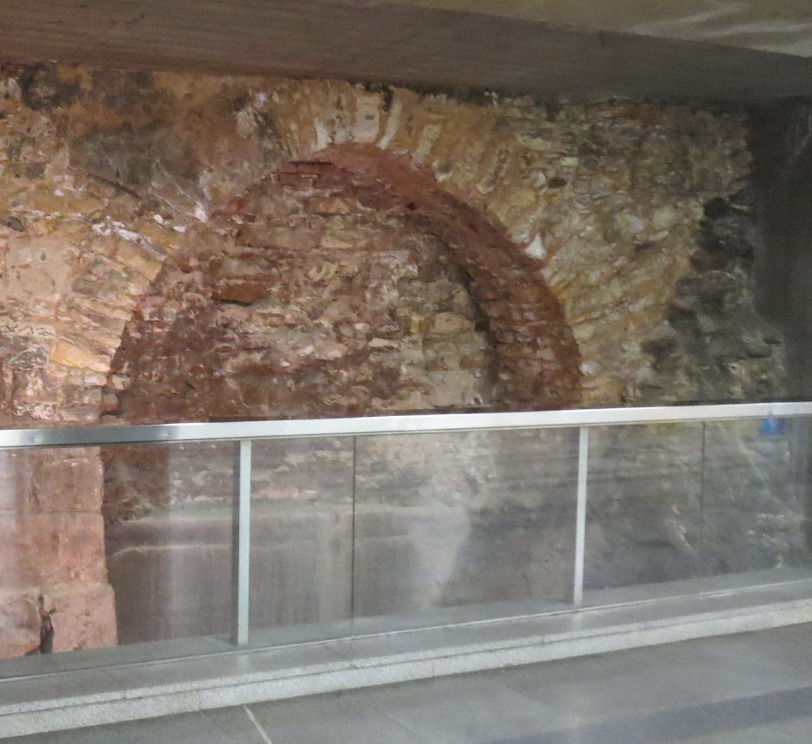
When the Můstek metro station opened on August 12, 197826, they incorporated the preserved remains of the medieval bridge into the station’s design27. Today, you can see the northern arch and abutment of the bridge embedded in a wall of the vestibule at the Můstek metro station. The bridge is located in the vestibule at the northwest end of Wenceslas Square, where it serves as a tangible connection to the city’s medieval past.
Prague’s Můstek neighborhood represents a fascinating example of how urban spaces evolve while maintaining connections to historical origins. From a critical defensive crossing point in medieval Prague to a busy modern metro station, Můstek maintained its identity through centuries of development and change. The preservation of the medieval bridge within the metro station creates a direct visual link between present-day Prague and its medieval past, allowing modern visitors to literally stand before a piece of history that was buried and forgotten for hundreds of years.
References
- Tours-prague.eu. (2019). Prague Old Town: History and Things to Do. [online] Available at: https://www.tours-prague.eu/prague-old-town.phtml [Accessed 19 Apr. 2025][↩]
- GPSmyCity. (2025). Old Town Walking Tour. [online] Available at: https://www.gpsmycity.com/tours/old-town-walking-tour-2446.html [Accessed 19 Apr. 2025][↩]
- Alex (2021). Můstek (Little Bridge). [online] The Prague Vitruvius. Available at: https://pragitecture.eu/mustek-little-bridge/[↩]
- Ourbeautifulprague.com. (2025). Available at: https://www.ourbeautifulprague.com/mustek/ [Accessed 19 Apr. 2025][↩]
- Ourbeautifulprague.com. (2025). Available at: https://www.ourbeautifulprague.com/mustek/ [Accessed 19 Apr. 2025][↩]
- Alex (2021). Můstek (Little Bridge). [online] The Prague Vitruvius. Available at: https://pragitecture.eu/mustek-little-bridge/[↩]
- Věra Nemochovská (2023). Bastion at Calvary | Prague Views. [online] Prague Views. Available at: https://pragueviews.com/bastion-at-calvary/ [Accessed 19 Apr. 2025][↩]
- Věra Nemochovská (2023). Bastion at Calvary | Prague Views. [online] Prague Views. Available at: https://pragueviews.com/bastion-at-calvary/ [Accessed 19 Apr. 2025][↩]
- Věra Nemochovská (2023). Bastion at Calvary | Prague Views. [online] Prague Views. Available at: https://pragueviews.com/bastion-at-calvary/ [Accessed 19 Apr. 2025][↩]
- Věra Nemochovská (2023). Bastion at Calvary | Prague Views. [online] Prague Views. Available at: https://pragueviews.com/bastion-at-calvary/ [Accessed 19 Apr. 2025][↩]
- Věra Nemochovská (2023). Bastion at Calvary | Prague Views. [online] Prague Views. Available at: https://pragueviews.com/bastion-at-calvary/ [Accessed 19 Apr. 2025][↩]
- Ourbeautifulprague.com. (2025). Available at: https://www.ourbeautifulprague.com/mustek/ [Accessed 19 Apr. 2025][↩]
- Radio Prague International. (2024). Discovering Můstek, named after the medieval bridge unearthed by builders. [online] Available at: https://english.radio.cz/discovering-mustek-named-after-medieval-bridge-unearthed-builders-8836229 [Accessed 19 Apr. 2025][↩]
- Radio Prague International. (2024). Discovering Můstek, named after the medieval bridge unearthed by builders. [online] Available at: https://english.radio.cz/discovering-mustek-named-after-medieval-bridge-unearthed-builders-8836229 [Accessed 19 Apr. 2025][↩]
- Ourbeautifulprague.com. (2025). Available at: https://www.ourbeautifulprague.com/mustek/ [Accessed 19 Apr. 2025][↩]
- Radio Prague International. (2024). Discovering Můstek, named after the medieval bridge unearthed by builders. [online] Available at: https://english.radio.cz/discovering-mustek-named-after-medieval-bridge-unearthed-builders-8836229 [Accessed 19 Apr. 2025][↩]
- Alex (2021). Můstek (Little Bridge). [online] The Prague Vitruvius. Available at: https://pragitecture.eu/mustek-little-bridge/[↩]
- Ourbeautifulprague.com. (2025). Available at: https://www.ourbeautifulprague.com/mustek/ [Accessed 19 Apr. 2025][↩]
- Alex (2021). Můstek (Little Bridge). [online] The Prague Vitruvius. Available at: https://pragitecture.eu/mustek-little-bridge/[↩]
- Alex (2021). Můstek (Little Bridge). [online] The Prague Vitruvius. Available at: https://pragitecture.eu/mustek-little-bridge/[↩]
- Alex (2021). Můstek (Little Bridge). [online] The Prague Vitruvius. Available at: https://pragitecture.eu/mustek-little-bridge/[↩]
- Ourbeautifulprague.com. (2025). Available at: https://www.ourbeautifulprague.com/mustek/ [Accessed 19 Apr. 2025][↩]
- Ourbeautifulprague.com. (2025). Available at: https://www.ourbeautifulprague.com/mustek/ [Accessed 19 Apr. 2025][↩]
- Alex (2021). Můstek (Little Bridge). [online] The Prague Vitruvius. Available at: https://pragitecture.eu/mustek-little-bridge/[↩]
- Alex (2021). Můstek (Little Bridge). [online] The Prague Vitruvius. Available at: https://pragitecture.eu/mustek-little-bridge/[↩]
- Radio Prague International. (2024). Discovering Můstek, named after the medieval bridge unearthed by builders. [online] Available at: https://english.radio.cz/discovering-mustek-named-after-medieval-bridge-unearthed-builders-8836229 [Accessed 19 Apr. 2025][↩]
- Alex (2021). Můstek (Little Bridge). [online] The Prague Vitruvius. Available at: https://pragitecture.eu/mustek-little-bridge/[↩]
Would you like to receive more of this kind of content by email? Fill in your details and we'll keep you up to date!